
Wouldn't It Be Nice?

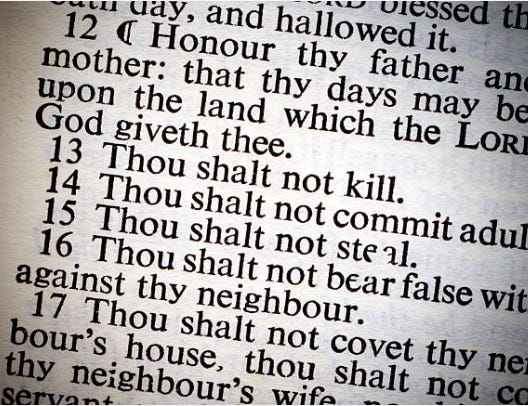
With the utmost respect for Brian Wilson, I’m convinced he wasn’t thinking about the Ten Commandments when he wrote the song with the same title as this post – although there is a seam of connectivity. As with any widely read literature, there are as many perspectives on the Ten Commandments as there are readers who perceive.
This post reflects my current perspective.
The Ten Commandments have been studied, analyzed, interpreted, debated, ignored, commercialized, and politicized, for millennia, by those who scrutinize professionally, and those who scrutinize as a hobby. Whether professional or amateur, we all share an incomplete understanding regarding the intended purpose of these commands. The most common view, I suspect, is that the commands are God-authored and God-delivered to various groupings of people, establishing a moral code that distinguishes God-pleasing behavior from behavior that doesn’t – therefore, our responsibility is to follow the code.
Truth is hidden in there somewhere.
Jewish scholars refer to them as the Ten Words. Different paradigms are created and nurtured by contrasting the two terms. I prefer “words.” In addition, I believe these “words” reflect a God who created humanity in His image, to be a partner in caring for His creation. Obviously, we’ve struggled. Our struggles haven’t changed God’s purpose. God continually and relentlessly pursues His purpose. The “words” are given for mutual benefit. God’s image and purpose is upheld and visible on earth as in heaven, God’s creation is governed in a nurturing way, and humanity occasionally brushes with integrity, respect, and grace.
These “words” were given to reflect God in us, and included benefit for us. Just consider, please, if we lived by these “words”, how stark the contrast with the world we find ourselves existing in today? We would continue His original and intended purpose of bringing peace and order into chaos – light into darkness – the image of God on earth. In that way, the “words” are the consummate spiritual formation approach; God shaping humanity in His image.
Prior to these “words” being given, there had been a long history of inability and failure to reflect our Creator. Inability and failure continue.
When we see the “words” as commands, we conclude that these are behaviors that determine whether we please God or not – contrasting who we are versus what we do. It seems to me, what we do doesn’t always reflect who we are. The focus of the words is to show us how we would be if we reflected the true character and image of God. They also show us our own inability to perfectly reflect God’s character. If true, the point about behavior discipline in order to please God is moot.
The purpose of the commands or words, is like a two-way glass. It is a window to see God as He is, and a mirror to show us as we are. The gap is Windex clear.
Consider a discussion Jesus had about these words. He was asked, by a professional, which one, of all the commands, was the greatest. Jesus told him there were two – love God with all our hearts and love our neighbors as we love ourselves. He said that all the Law is based on these two. Don’t both reflect God?
Some conclude that the first four are oriented toward loving God, and the final six toward loving neighbors. Such is the beauty of wisdom literature and its spawning contemplation. That view is common, and with some merit, but it hides an important truth – all failure in the Law is failure against God. James 2:1-13 confirms this thought in a clear, concise way.
Jesus’ claim to complete the Law, is about our being as more important than our doing. This is the basis of spiritual formation – shaping us into His image.
As we consider the two-fold purpose of reflecting God and benefitting creation, I want us to spend a moment with the second part of the purpose.
Wouldn’t it be nice to live in a world of people who reflected God – as opposed to a world of people who reflect the God they’ve created? We’ll use the ten as God’s self-description.
First of all, God introduces Himself as the Author of the words – invoking His name and recent history of gracious commitment to His chosen people, saying:
“I AM, the Lord your God, who brought you out of the land of Egypt, out of the house of slavery, and………..”.
In one sentence, God states His name – a name that reflects His freedom and His sovereignty – and in that freedom and sovereignty, His grace and love to deliver and rescue His holy people.
God then describes Himself, and by intentional association, His image:
Of all their gods, including themselves, He is the true God.
He is not their image. They will not shape Him, as they do other gods, nor worship any god of their shaping.
He is passionate about their “marriage.” They will be faithful – not claiming to be His partner and cheating on Him.
They will honor His gracious providence; they will trust and depend on Him, and be satisfied
They will be honorable and respectful; particularly toward those who give life and nurture
They will honor life, protect it, and nurture it.
They will honor commitment, and uphold relationship integrity
They will be satisfied with what they have, and not take the fruit of someone else’s work.
They will honor truth; not using dishonesty as a weapon of personal advantage
They will be satisfied with whatever they’ve received – not comparing and desiring what others have received.
Can you imagine living in a world like that?
As the Beach Boys sang, “wouldn’t it be nice to live together in the kind of world where we belong?”
“Maybe if we think and wish and hope and pray, it might come true.”
“You know it seems the more we talk about it, it only makes it worse to live without it. But let’s talk about it. Oh, wouldn’t it be nice”?